OPD-V: Visual On-Policy Self-Distillation with Modality Balance
Visual teacher contrasts select self-distillation tokens that receive stronger support from the image.

The short version
OPD-V examines modality imbalance in visual on-policy self-distillation. A teacher can be confident while relying mainly on textual context, leaving the additional visual information underused. The method contrasts a zoom-in positive teacher with an image-masked negative teacher under matched text and student-generated prefixes.
Their token-logit margin defines a modality-balance trust region. Distillation focuses on tokens for which the positive visual condition supplies stronger support, connecting the selection of supervision to evidence use rather than treating every confident teacher output equally.
A useful distillation signal should reward how a teacher uses visual evidence, alongside what it predicts.
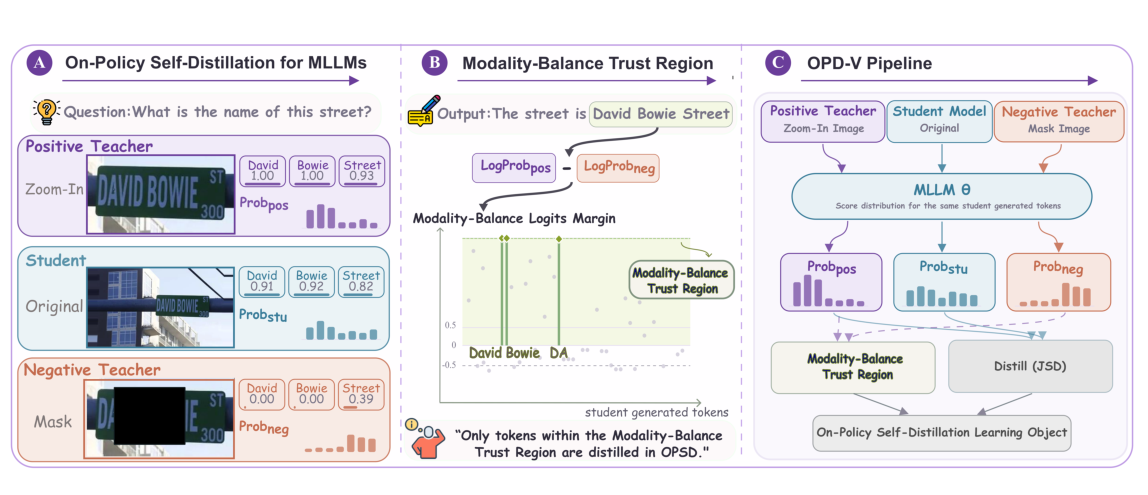
Selecting visually supported updates
Positive and negative teacher conditions define a token-level trust region for on-policy distillation.
View in the paperWhy this matters
Privileged information improves training only when the teacher effectively uses it. In a multimodal model, confidence and correctness alone may not reveal whether an apparent reasoning signal depends on the image.
How it works
- Score the same student-generated tokens with the original-image student, zoom-in positive teacher, and masked-image negative teacher.
- Use positive modality-balance logit margins to select an on-policy trust region.
- Apply Jensen–Shannon self-distillation from the positive teacher on the selected tokens and compare quality and training cost.
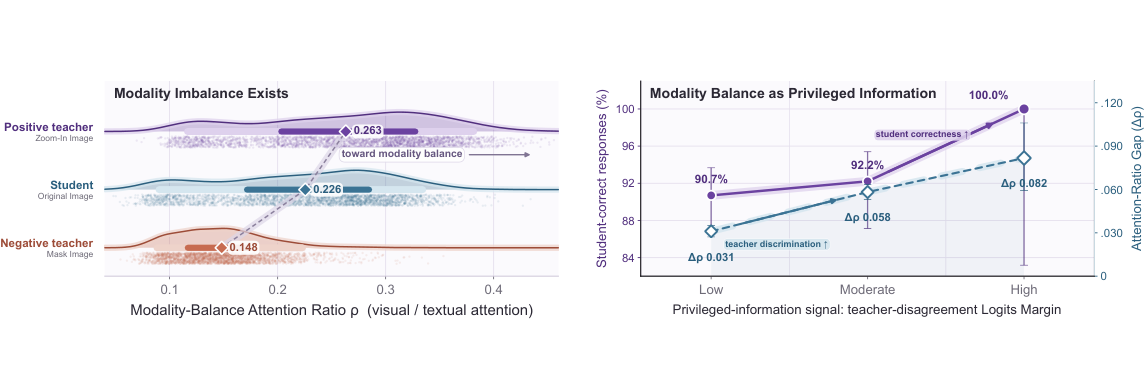
Modality balance as a diagnostic
The analysis links visual-attention balance, teacher behavior, and the proposed privileged signal.
View in the paperWhat the study finds
Experiments span six benchmarks, four multimodal backbones, and five post-training methods. Analyses compare attention balance and teacher behavior, training dynamics, component ablations, and wall-clock step time. The reported results support the proposed supervision-selection criterion in those settings.
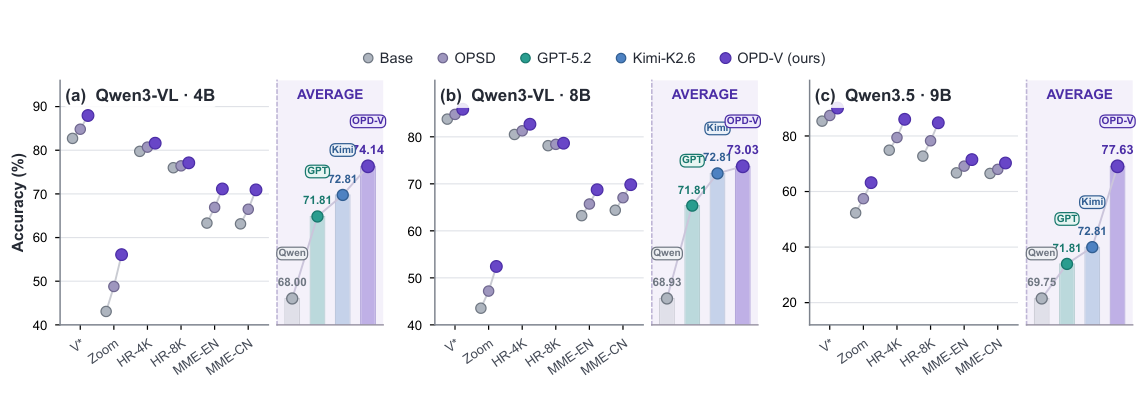
Comparisons across backbones
The source plots compare benchmark accuracy across model architectures and post-training methods.
View in the paperWhat this means
The work treats the quality of supervision as partly a question of information dependence. Contrasting visual conditions helps identify where a teacher’s support is associated with richer visual input, providing a practical way to use that distinction during training.
This connects evaluation and optimization: a diagnostic of modality use becomes a criterion for selecting which updates to trust. The larger question is when that criterion continues to track genuinely useful evidence across image transformations, tasks, and model families.
Paper and resources
This is an introduction to the linked paper. Refer to the original for method definitions, evaluation settings, and complete results.
Cite this work
@misc{opd_v,
  title = {OPD-V: Visual On-Policy Self-Distillation with Modality Balance},
  author = {Aniri and Bi, Jinhe and Liao, Peng and Jin, Zengjie and Tresp, Volker and Shen, Fei and Ma, Yunpu and Chua, Tat-Seng},
  year = {2026},
  eprint = {2608.05131},
  archivePrefix = {arXiv},
  url = {https://arxiv.org/abs/2608.05131}
}