MAE I Trust Myself? Self-Evaluating VLA Action Generation with Markov Attention Entropy
Architecture-aware attention entropy turns a VLA’s internal visual addressing into an action-reliability signal.

The short version
MAE studies whether vision–language–action models can assess their own action generation using internal attention signals. A conditional generative Markov-chain view supplies a common abstraction across latent readout and latent refinement, while the score remains aware of their different computational roles.
That distinction matters: visual concentration associated with reliable readout does not imply that the same entropy orientation is appropriate for iterative refinement. MAE-D and MAE-C use architecture-aware orientations, turning visual addressing into comparable reliability rankings without expert failure labels for score training.
A reliability signal must be interpreted in relation to the computation that produces the action.
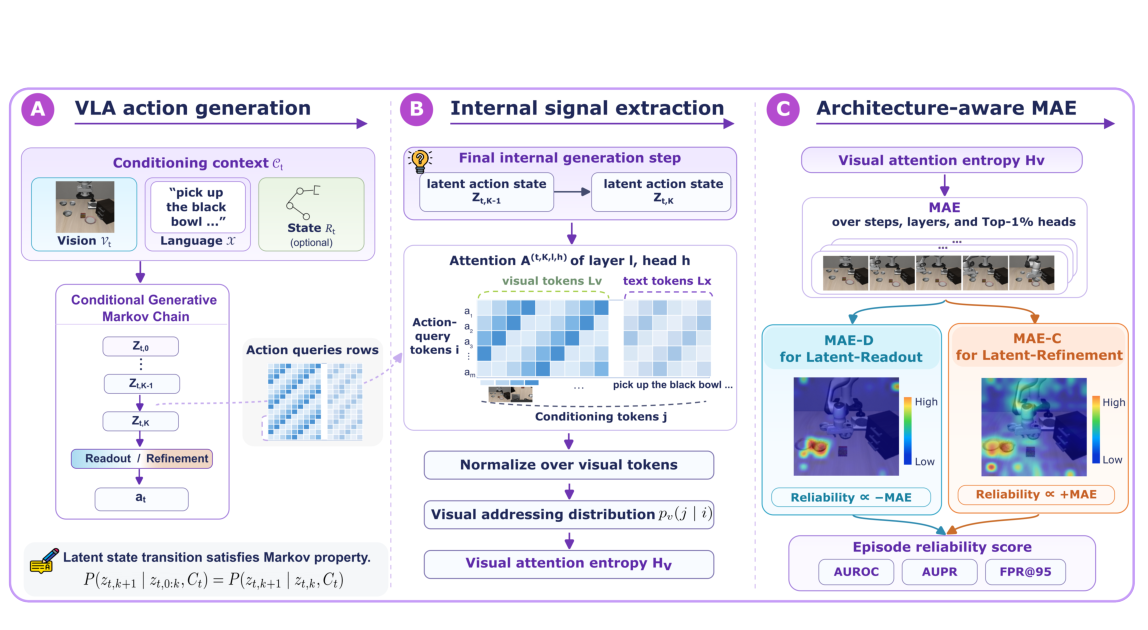
A shared view with architecture-aware readout
The framework extracts internal visual addressing and applies the appropriate MAE orientation.
View in the paperWhy this matters
Output uncertainty provides only a partial view of robotic action generation, especially when policies use different action heads or refinement procedures. Internal signals may contain additional evidence, but a uniform interpretation can erase the architectural differences that give those signals meaning.
How it works
- Represent heterogeneous action-generation procedures through a shared conditional latent-transition abstraction.
- Extract visual-attention entropy and use the appropriate orientation for latent-readout or latent-refinement policies.
- Evaluate reliability rankings on LIBERO-Reflect with standard and challenging episodes across several task subsets.
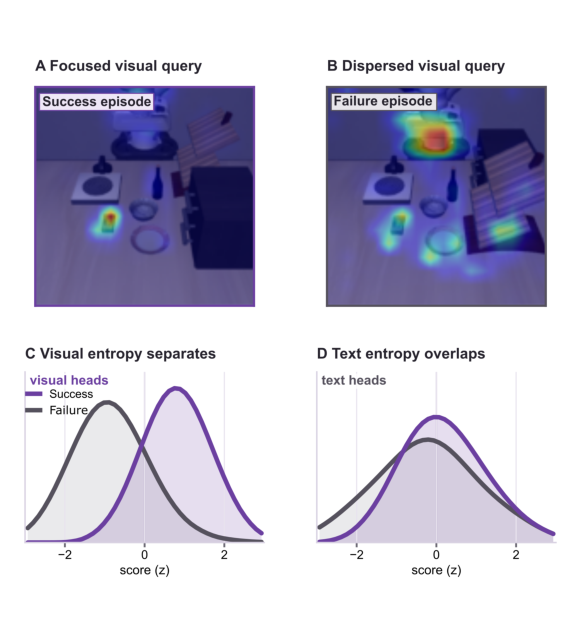
Visual attention and outcome
Example attention maps and score distributions compare successful and failed episodes and visual versus text signals.
View in the paperWhat the study finds
LIBERO-Reflect contains 4,000 episodes, split evenly between standard and challenging conditions. Evaluations cover OpenVLA, OpenVLA-OFT, and QwenPI-Flow and report AUPR, AUROC, and FPR@95. Ablations compare visual and text heads, selection scope, efficiency, and repeated simulator seeds.
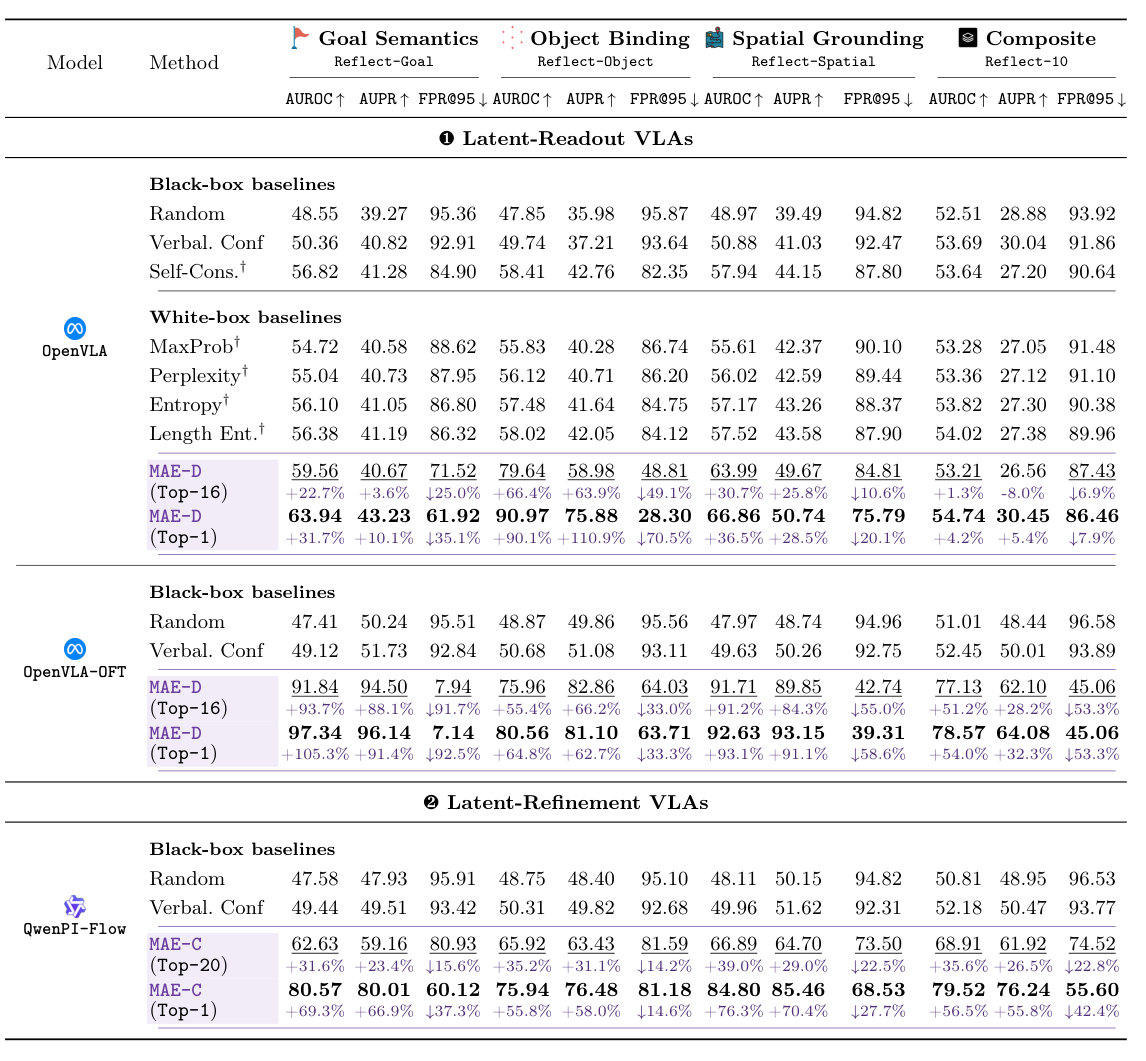
Reliability across heterogeneous policies
The source table compares evaluation metrics across three policies and the benchmark’s task subsets.
View in the paperWhat this means
The work connects self-evaluation to the structure of the computation being evaluated. Attention entropy becomes useful when its direction and location are matched to the action-generation mechanism; the same numerical tendency can mean different things in different architectures.
This offers a route toward monitoring based on existing internal information. A reliability ranking can inform future decisions about intervention or fallback, while threshold calibration and closed-loop benefits require their own evaluation beyond a successful ranking experiment.
Paper and resources
This is an introduction to the linked paper. Refer to the original for method definitions, evaluation settings, and complete results.
Cite this work
@misc{mae_vla,
  title = {MAE I Trust Myself? Self-Evaluating VLA Action Generation with Markov Attention Entropy},
  author = {Aniri and Chen, Yilin and Bi, Jinhe and Jin, Zengjie and Wang, Yujun and Tian, Yijun and Tresp, Volker and Shen, Fei and Chua, Tat-Seng and Ma, Yunpu},
  year = {2026},
  eprint = {2608.16697},
  archivePrefix = {arXiv},
  url = {https://arxiv.org/abs/2608.16697}
}