Do correct answers have stable latent knowledge support?
A correct answer is an observable outcome. This study asks whether its internal knowledge support stays stable when the elicitation condition changes.

The short version
This study separates whether a model answers correctly from how consistently its internal knowledge survives controlled changes in the question. Local state stability and relational geometry offer complementary views of that consistency. EpiStableBench tests paraphrase, format, context, and language variations, making the gap between a successful answer and a stable knowledge state measurable.
The resulting picture is more informative than accuracy alone. Items that look equivalent at the output can differ in their internal stability and in their subsequent correctness. The study also explores using latent stability to guide preference optimization, connecting diagnosis to a possible intervention.
A correct answer is one observation; stable knowledge is a property of the representation behind it.
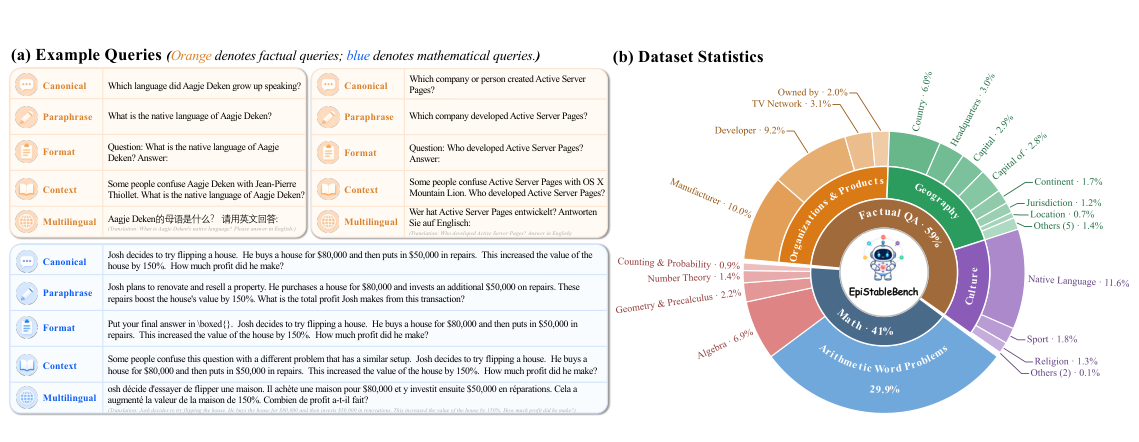
A benchmark for knowledge stability
EpiStableBench varies the elicitation conditions while controlling the underlying knowledge item.
View in the paperWhy this matters
Output accuracy alone cannot determine whether an answer rests on stable representations. Controlled changes in how knowledge is elicited provide a way to examine the support behind the answer.
How it works
- Average representations within each elicitation condition and correct shared shifts relative to a baseline.
- Use LSS for normalized state displacement and KTS for cross-condition consistency of pairwise distances.
- Evaluate controlled queries in EpiStableBench and use stability-aware preferences in LatentDPO.
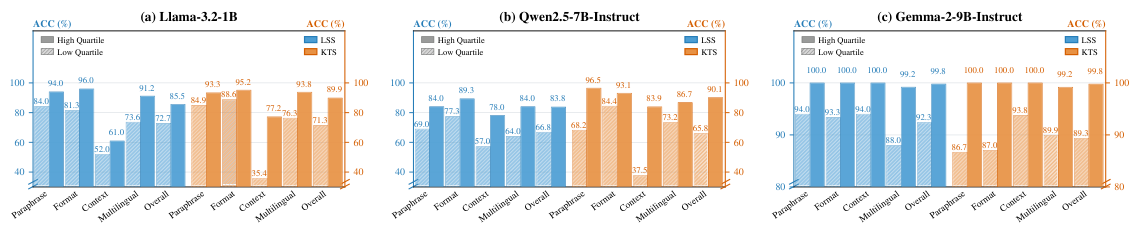
Correct now, reliable later?
Among initially correct items, higher-stability groups show different subsequent accuracy under held-out elicitation conditions.
View in the paperWhat the study finds
EpiStableBench includes 4,411 items and 76,766 controlled queries. Across 16 LLMs, higher within-model stability generally accompanies better held-out accuracy, while larger or more accurate models are not consistently more stable. LatentDPO improves editing success and generalization in the evaluated integrations.
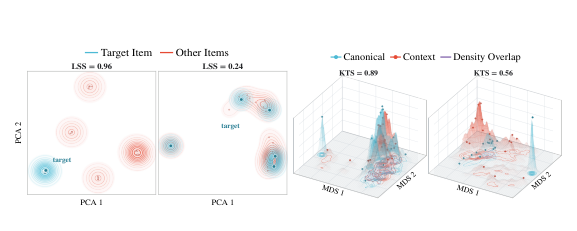
Two geometric views of stability
Local state concentration and relational overlap illustrate complementary aspects of internal knowledge stability.
View in the paperWhat this means
Reliable evaluation needs to characterize the conditions under which knowledge remains accessible. A single correct response can conceal sensitivity to how the same information is elicited. Internal stability provides an additional axis for diagnosing that fragility and selecting cases for further scrutiny.
This opens a route toward evaluation that connects representation, elicitation, and behavior. The relationship must be calibrated within its setting: scores across different models are not automatically comparable, and a geometric indicator is evidence about reliability rather than a guarantee of truth.
Paper and resources
This is an introduction to the linked paper. Refer to the original for method definitions, evaluation settings, and complete results.
Cite this work
@misc{latent_support,
  title = {Do correct answers have stable latent knowledge support?},
  author = {Shi, Chuancheng and Li, Shangze and Wu, Wenhua and Hu, Kun and Shen, Fei and Wang, Zhiyong and Chua, Tat-Seng},
  year = {2026},
  eprint = {2610.15277},
  archivePrefix = {arXiv},
  url = {https://arxiv.org/abs/2610.15277}
}