Who Bridges Safety? Identifying and Targeting Cross-Lingual Shared Safety Pathways
Trace cross-layer safety pathways through MLP neurons to identify shared cross-lingual mechanisms for targeted safety alignment.

The short version
Who Bridges Safety studies multilingual safety as a problem of signal propagation. It identifies cross-layer pathways using both co-activation and activation-propagation measurements, then examines the paths shared by high-resource and non-high-resource languages. The unit of analysis is a connection between components, extending the view provided by isolated-neuron measurements.
The resulting shared pathways guide selective alignment. Masking experiments test their functional relevance, while targeted updates examine whether strengthening the shared computation improves refusal behavior in less well-protected languages without broadly changing the model.
A shared safety component matters through the computation it helps carry across layers and languages.
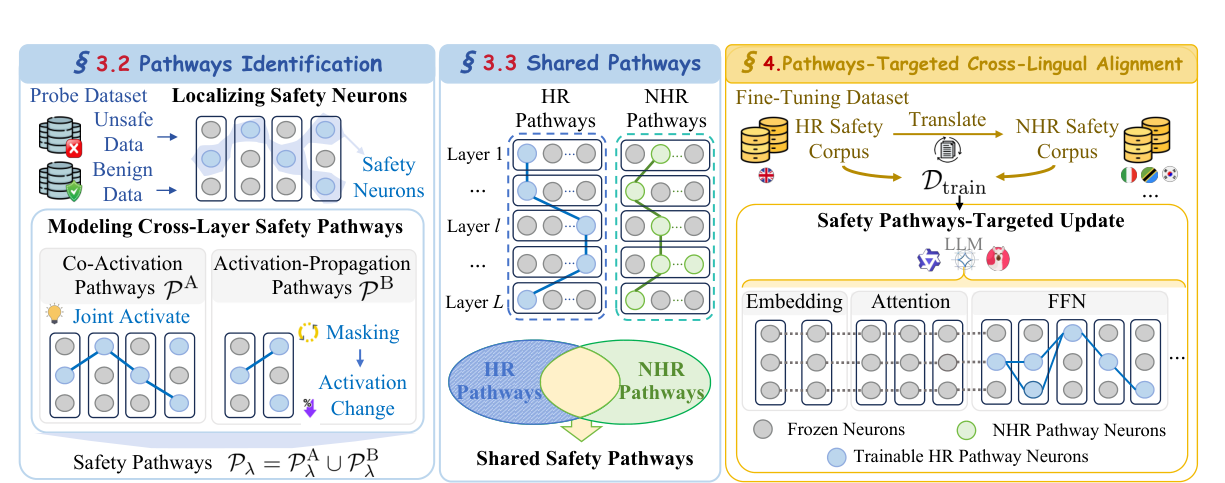
Following safety signals across layers
The framework combines pathway identification, cross-language intersection, and pathway-targeted alignment.
View in the paperWhy this matters
Models can understand a language while failing to apply a safety judgment in it. Locating individual safety-related neurons helps identify relevant components, but leaves open how their signals combine and propagate into a refusal decision.
How it works
- Identify language-specific safety pathways from cross-layer co-activation and activation propagation.
- Intersect the pathway sets across languages and compare targeted masking with size-matched random controls.
- Concentrate alignment updates on shared pathway parameters and evaluate multilingual safety together with general capabilities.
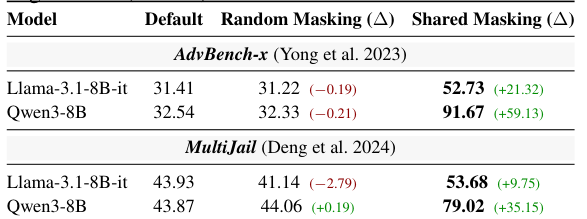
Testing the shared pathways
Shared-path masking is compared with a size-matched random control on multilingual attacks.
View in the paperWhat the study finds
The selected masking controls show larger safety degradation when shared pathways are disrupted than when matched random pathways are disrupted. Multilingual evaluations compare targeted alignment with preference-optimization and cross-language baselines; additional experiments examine training efficiency, general capability retention, and leave-one-language-out transfer.
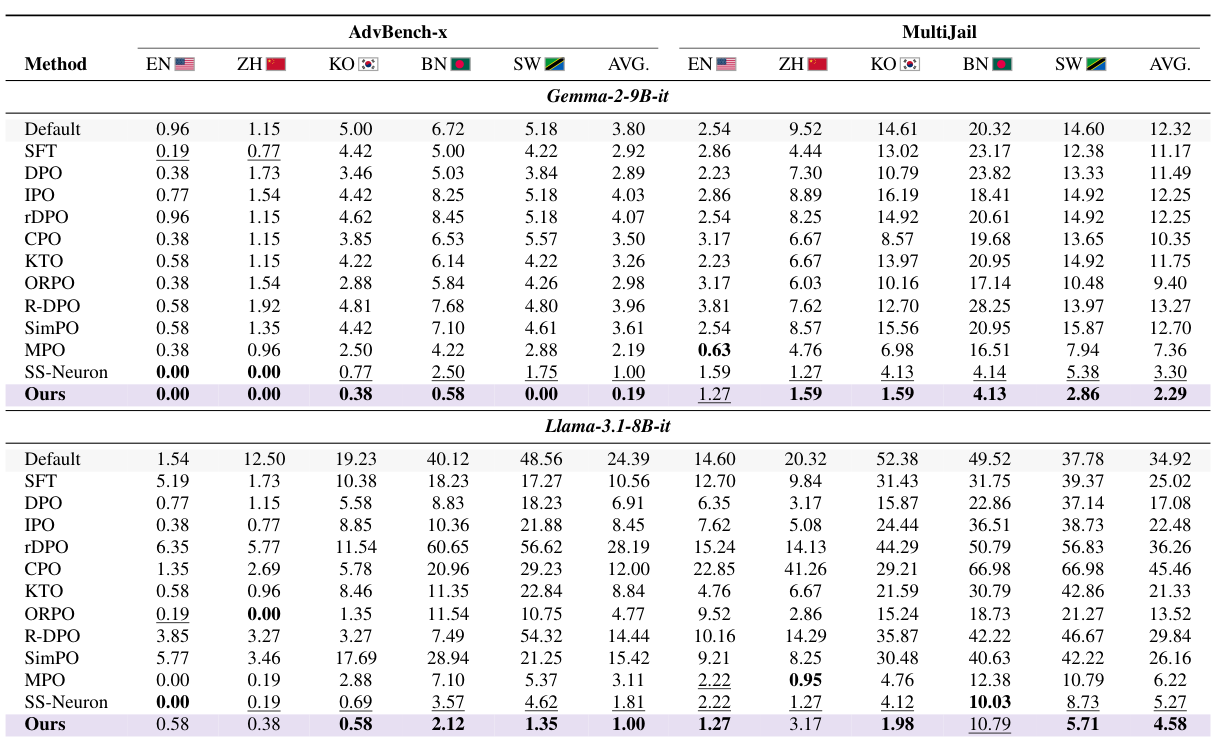
Multilingual safety after alignment
The original table compares attack success rates across languages and alignment methods.
View in the paperWhat this means
The work makes the connectivity of a safety mechanism an explicit research target. A model may contain relevant components yet fail to coordinate them effectively in a particular language. Path-level analysis connects those two possibilities to interventions that can be tested.
This suggests a mechanism-aware approach to transfer: identify a shared computation, validate its role, and then optimize where that computation is carried. The evidence supports the studied pathway constructions and languages; how broadly those bridges generalize remains a question for further controlled evaluation.
Paper and resources
This is an introduction to the linked paper. Refer to the original for method definitions, evaluation settings, and complete results.
Cite this work
@misc{who_bridges_safety,
  title = {Who Bridges Safety? Identifying and Targeting Cross-Lingual Shared Safety Pathways},
  author = {Miao, Shuyi and Qiu, Wangjie and Shao, Pengyang and Xiao, Canran and Shen, Fei and Zheng, Zhiming and Chua, Tat-Seng},
  year = {2026},
  eprint = {2608.09095},
  archivePrefix = {arXiv},
  url = {https://arxiv.org/abs/2608.09095}
}