Who Transfers Safety? Identifying and Targeting Cross-Lingual Shared Safety Neurons
Identify shared safety neurons that connect high-resource and non-high-resource language behaviour.

The short version
This study identifies a small set of safety neurons shared across languages and tests their role through masking and targeted training. Their overlap connects safety behavior in high-resource and non-high-resource languages. SS-Neuron Expansion focuses optimization on the English safety neurons used as a bridge for cross-lingual transfer.
The evidence combines neuron-level interventions with multilingual attack evaluations. This connects an observed language disparity to a candidate internal mechanism, then asks whether training that mechanism improves safety across languages.
Cross-language safety transfer depends on which internal mechanisms languages share and can actually access.
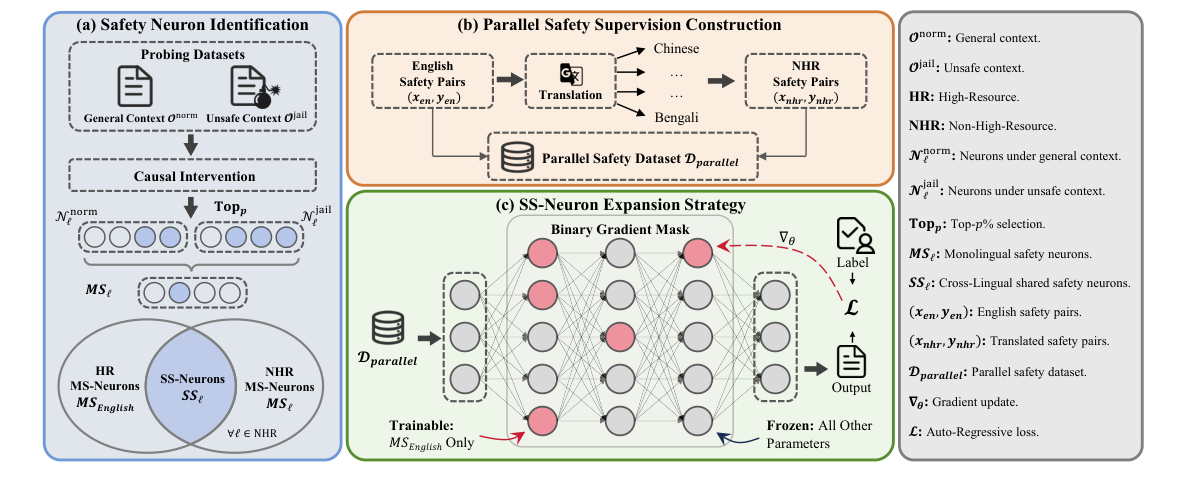
Finding and strengthening the bridge
The pipeline identifies shared safety neurons and selectively trains the cross-language bridge.
View in the paperWhy this matters
A model’s safety behaviour can differ sharply across languages. Understanding which internal components participate in that transfer can guide more focused alignment.
How it works
- Identify monolingual safety neurons and test their role through activation and suppression.
- Find the subset shared between high-resource and non-high-resource languages.
- Train the selected shared subset with a strategy accounting for language resources and model architecture.
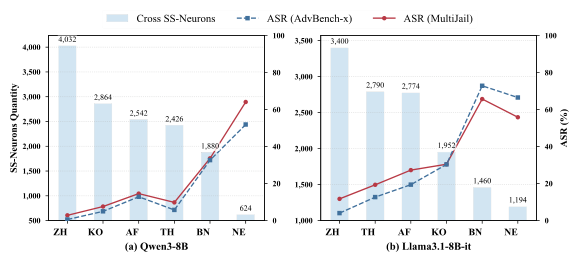
Shared mechanisms and safety behavior
The plot compares shared-neuron abundance with attack success rates; this particular relationship is correlational.
View in the paperWhat the study finds
Suppressing shared neurons causes concurrent safety drops in non-high-resource languages, while reinforcement improves cross-lingual consistency. Targeted fine-tuning reports stronger non-high-resource safety than the compared methods while maintaining general capabilities.
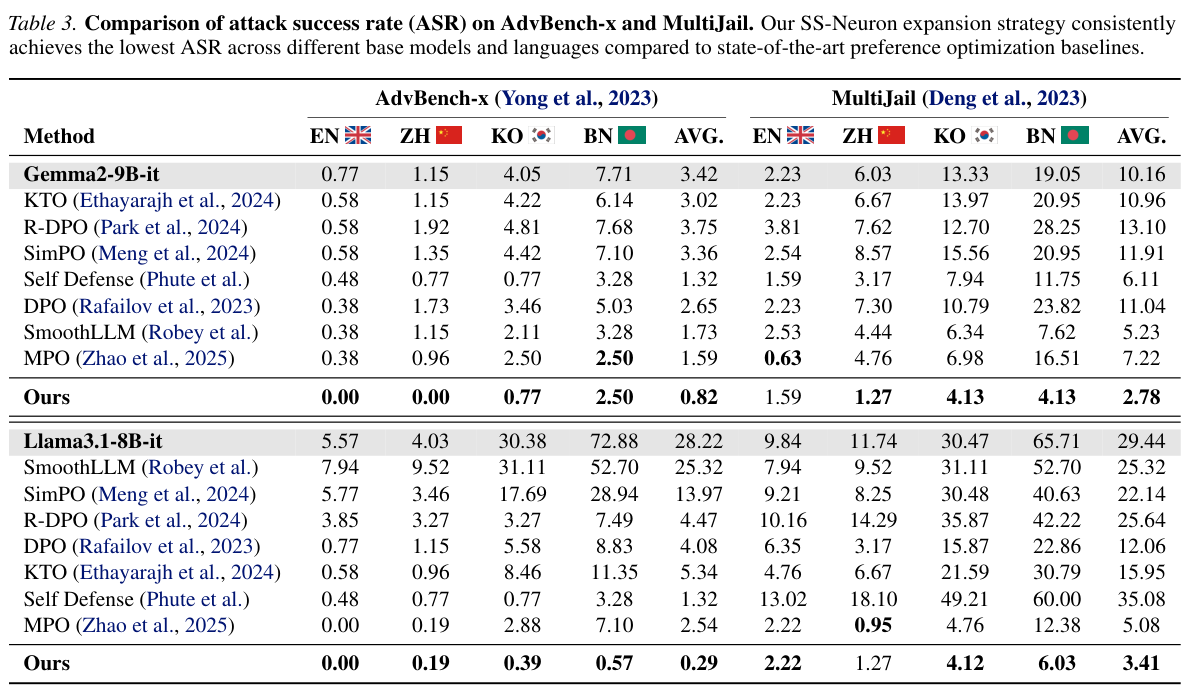
Testing cross-language safety transfer
The table reports multilingual attack success rates after targeted SS-Neuron Expansion training.
View in the paperWhat this means
A multilingual model can share parameters without sharing equally effective access to a safety mechanism. Locating the bridge helps make that distinction concrete and offers a principled target for allocating alignment effort where language coverage is uneven.
The broader research direction is mechanism-aware transfer: first identify what is shared, then test whether strengthening it benefits languages beyond those directly supervised. The quality of that transfer must be assessed together with general usefulness and language-specific failure modes.
Paper and resources
This is an introduction to the linked paper. Refer to the original for method definitions, evaluation settings, and complete results.
Cite this work
@misc{who_transfers_safety,
  title = {Who Transfers Safety? Identifying and Targeting Cross-Lingual Shared Safety Neurons},
  author = {Zhang, Xianhui and Xie, Chengyu and Zhu, Linxia and Yang, Yonghui and Zhao, Weixiang and Cheng, Zifeng and Wang, Cong and Shen, Fei and Chua, Tat-Seng},
  year = {2026},
  eprint = {2602.01283},
  archivePrefix = {arXiv},
  url = {https://arxiv.org/abs/2602.01283}
}