Where Culture Fades: Revealing the Cultural Gap in Text-to-Image Generation
A model may contain cultural knowledge yet fail to activate it when generating images from multilingual prompts.

The short version
Where Culture Fades investigates under-activation of cultural representations in text-to-image models. It traces where cultural information weakens, identifies sparse culture-related neurons, and tests inference-time activation and targeted enhancement. CultureBench connects these internal analyses to the cultural fidelity of generated images.
The study distinguishes possessing a representation from successfully expressing it. It examines whether changing the activation of existing knowledge can improve culture-specific generation while tracking generation quality and diversity.
Cultural knowledge can be present in a model yet fail to shape what it generates.
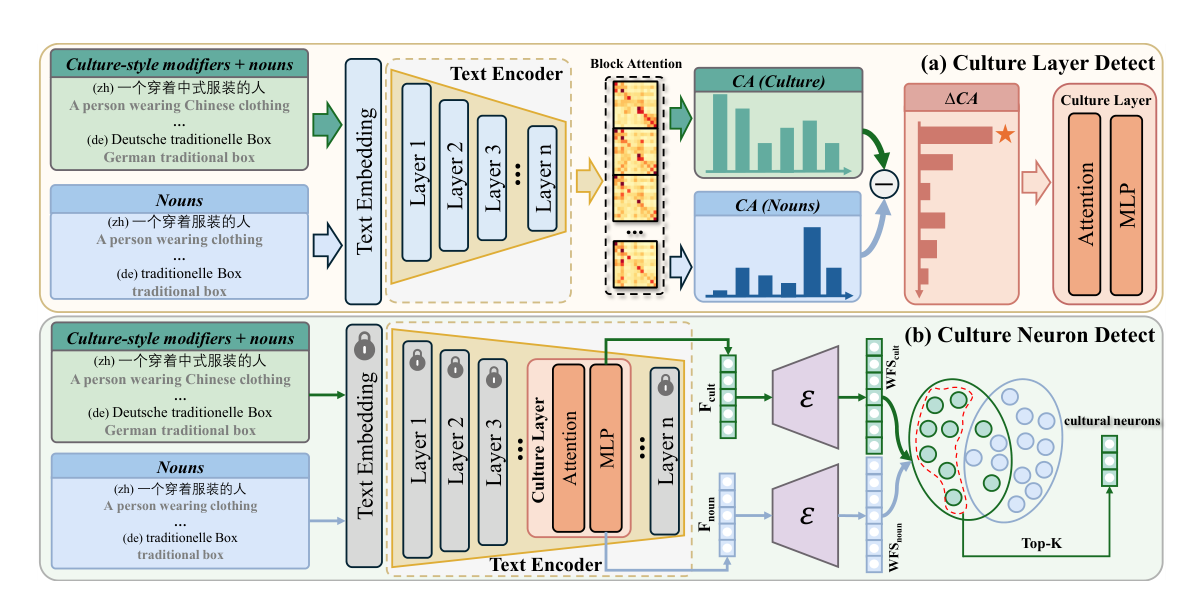
Tracing cultural information inside the model
Attention differences localize culture-sensitive layers, followed by sparse neuron detection.
View in the paperWhy this matters
Visual realism and semantic alignment do not ensure that images preserve the cultural connotations of a prompt across languages.
How it works
- Analyze cultural consistency under multilingual prompts in representative text-to-image models.
- Probe a small set of culture-sensitive neurons concentrated in selected layers.
- Amplify selected neurons at inference time or update only culturally relevant layers.
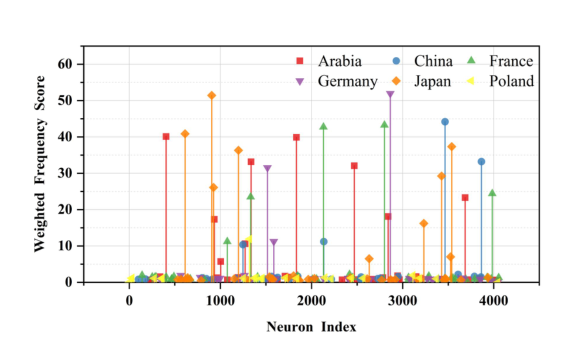
Sparse and culture-specific responses
Neuron-frequency peaks illustrate the concentration of culture-related responses.
View in the paperWhat the study finds
Analyses of two representative models support under-activation rather than simply missing knowledge. CultureBench evaluations report improved cultural consistency while preserving fidelity and diversity.
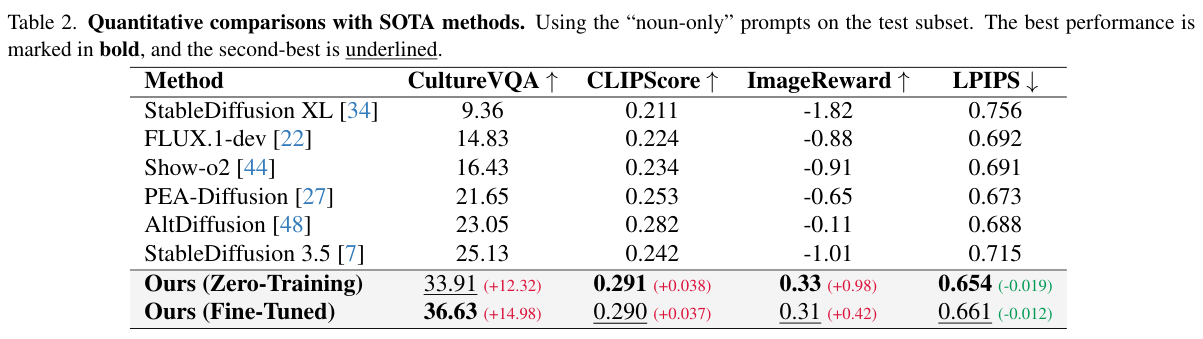
From internal activation to generated images
CultureBench metrics compare cultural fidelity alongside other generation measurements.
View in the paperWhat this means
This distinction matters whenever a model’s output is used to judge the scope of its knowledge. A generic image may reflect weak access to cultural detail, incomplete knowledge, or both. Internal analysis makes those explanations more separable and enables a more specific intervention.
The broader goal is culturally faithful generation grounded in identifiable mechanisms and measured outcomes. The reported findings establish a direction within the tested models and cultural coverage, while richer local evaluation remains essential for understanding what fidelity means across communities.
Paper and resources
This is an introduction to the linked paper. Refer to the original for method definitions, evaluation settings, and complete results.
Cite this work
@misc{where_culture_fades,
  title = {Where Culture Fades: Revealing the Cultural Gap in Text-to-Image Generation},
  author = {Shi, Chuancheng and Li, Shangze and Guo, Shiming and Xie, Simiao and Wu, Wenhua and Dou, Jingtong and Wu, Chao and Xiao, Canran and Wang, Cong and Cheng, Zifeng and Shen, Fei and Chua, Tat-Seng},
  year = {2025},
  eprint = {2511.17282},
  archivePrefix = {arXiv},
  url = {https://arxiv.org/abs/2511.17282}
}