Hub-Spectral Activation of Latent Multimodal Knowledge
A shared hub can hide useful cross-modal relations that native similarity scores do not reliably expose.

The short version
Hub-Spectral Activation studies latent relationships between modalities that share a hub. It builds a second-order view of the two hub-linked edges, identifies paired spectral directions, and uses them to read out a relation between the target modalities. The construction uses frozen representations without direct target-pair supervision.
The study tests this readout on retrieval and prototype classification. Permutation controls and source-sample analyses examine whether the improvements depend on meaningful correspondence in the hub edges, connecting performance gains to a concrete structural account.
What a representation can express may exceed what its default similarity interface can reveal.
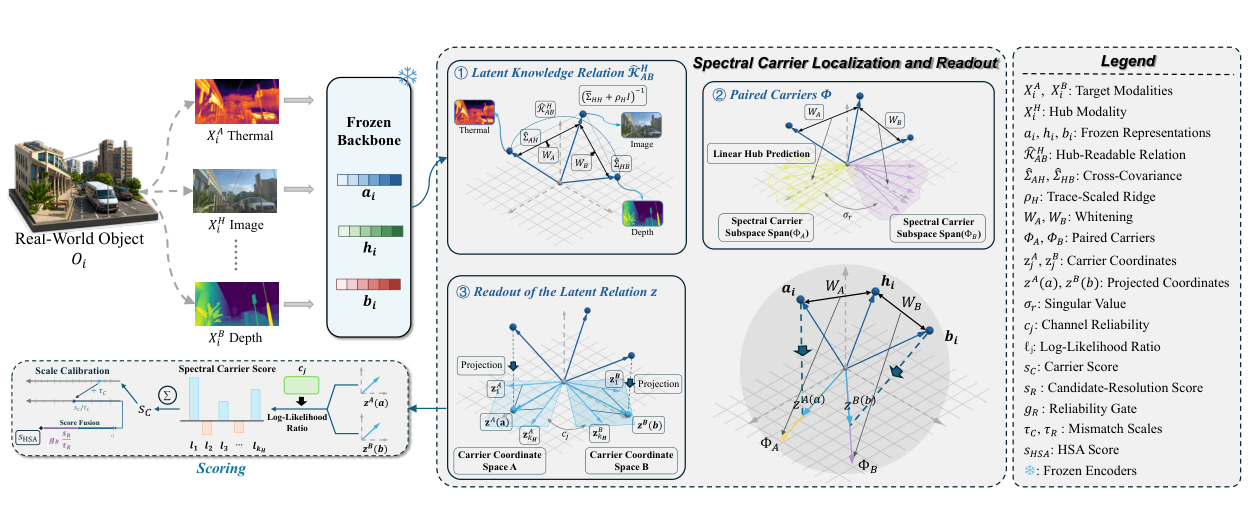
Reading a relation through a shared hub
Hub-linked statistics identify paired spectral carriers for a target relation without direct target-pair supervision.
View in the paperWhy this matters
Training two modalities against a shared hub does not guarantee their mutual alignment. The question is which part of their relation is identifiable from the two trained hub edges.
How it works
- Compose and standardize the second-order statistics of the two source-trained hub edges.
- Extract paired spectral directions to represent the hub-readable component.
- Combine reliability-weighted matching and source-gated candidate resolution for retrieval and prototype classification.
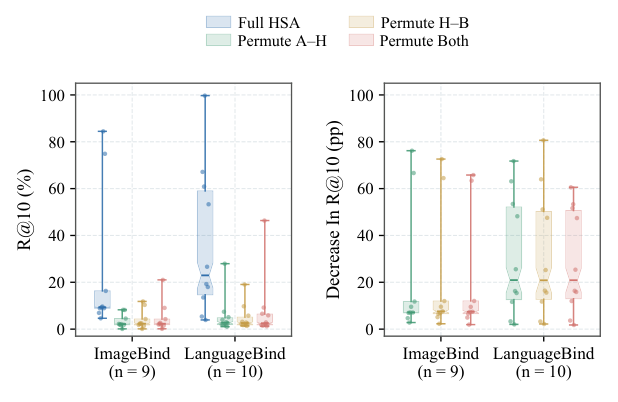
Testing whether correspondence matters
Permuting hub-edge correspondences tests the structural information that supports the readout.
View in the paperWhat the study finds
Across ImageBind and LanguageBind, mean bidirectional Recall@10 rises from 18.27% to 31.15% over 19 relations. Mean macro Top-1 rises from 29.01% to 52.43% over 11 prototype-classification relations.
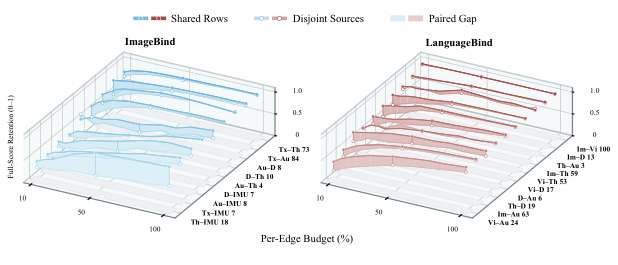
How source information affects recovery
Shared-row and disjoint-source estimates are compared as the source-sample budget changes.
View in the paperWhat this means
The central implication is a distinction between the information a model contains and the interface used to access it. Weak performance under frozen cosine similarity can reflect a limited readout of the available relational structure. Studying that interface can reveal capability that additional backbone training is not required to create in the tested setting.
Recoverability still depends on the hub and the statistical structure available in its two edges. The paper’s controls help define those conditions, suggesting a research program around when shared coordinates support useful cross-modal composition and when they do not.
Paper and resources
This is an introduction to the linked paper. Refer to the original for method definitions, evaluation settings, and complete results.
Cite this work
@misc{hub_spectral,
  title = {Hub-Spectral Activation of Latent Multimodal Knowledge},
  author = {Guo, Ying and Chen, Haidong and Xu, Linrui and Liu, Xiaohao and Shi, Chuancheng and Xiao, Canran and Zhang, Dan and Shen, Fei and Shen, Li and Chua, Tat-Seng},
  year = {2026},
  eprint = {2609.17094},
  archivePrefix = {arXiv},
  url = {https://arxiv.org/abs/2609.17094}
}