Latent Anomaly Knowledge Excavation: Unveiling Sparse Sensitive Neurons in Vision-Language Models
Excavate anomaly-sensitive neurons already present in a vision-language model using a small set of normal samples.

The short version
LAKE uses a small collection of normal images to locate anomaly-sensitive units in a frozen vision-language model. Patch-level structural deviations and cross-modal semantic signals are combined into an anomaly score. The backbone supplies the representation; normal examples help identify how that representation should be read.
The approach links localization to detection without gradient-based backbone adaptation. Quantitative evaluations and spatial anomaly maps examine whether the selected signals can identify unfamiliar defects and localize their regions.
Normal examples can reveal which parts of a pretrained representation are useful for detecting the abnormal.
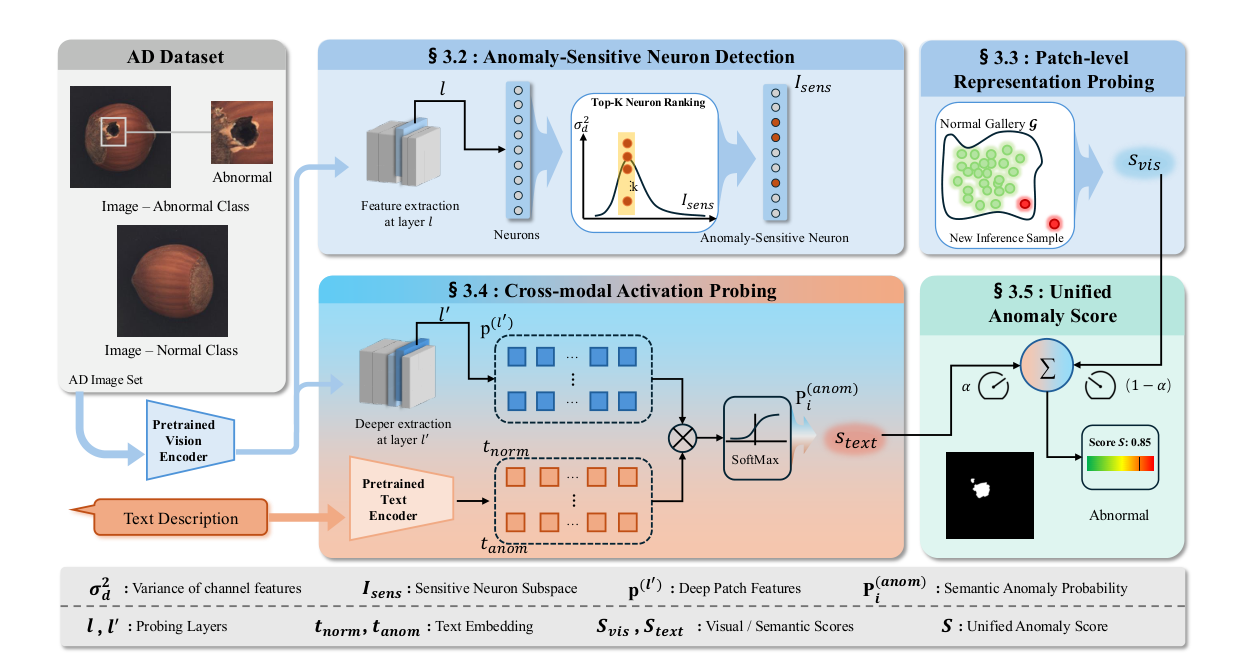
Reading anomaly-sensitive knowledge
Normal examples select sensitive units, and structural and semantic signals form a unified anomaly score.
View in the paperWhy this matters
Treating a VLM as a black-box feature extractor can obscure which internal signals support anomaly detection. LAKE examines whether those signals can be selected and elicited directly.
How it works
- Use a minimal set of normal samples to identify anomaly-sensitive neurons in the pretrained model.
- Isolate the selected signals to construct a compact representation of normality.
- Combine visual structural deviations with cross-modal semantic activations for anomaly scoring.
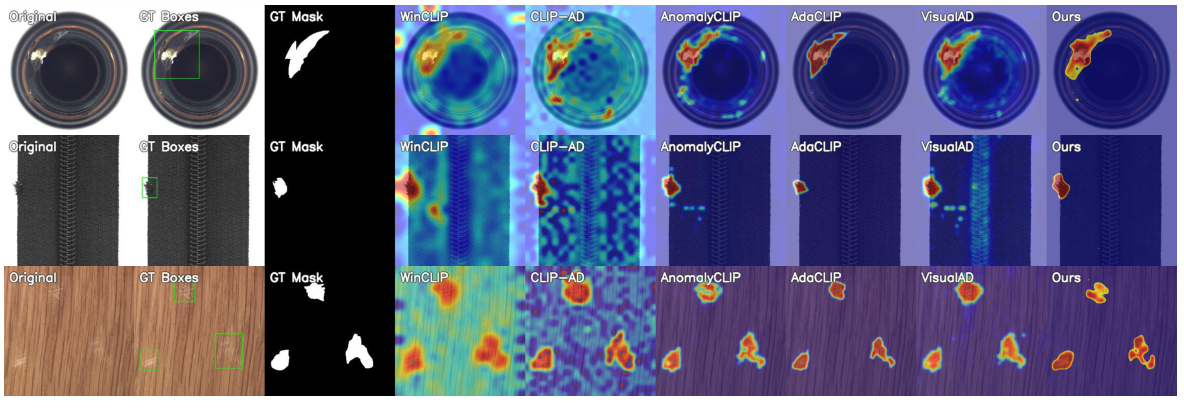
Seeing where the anomaly is
Original localization maps compare predicted anomalous regions with ground-truth masks and baseline methods.
View in the paperWhat the study finds
Evaluation on industrial anomaly-detection benchmarks reports strong performance together with neuron-level interpretability. The approach uses normal samples and does not train a new backbone.
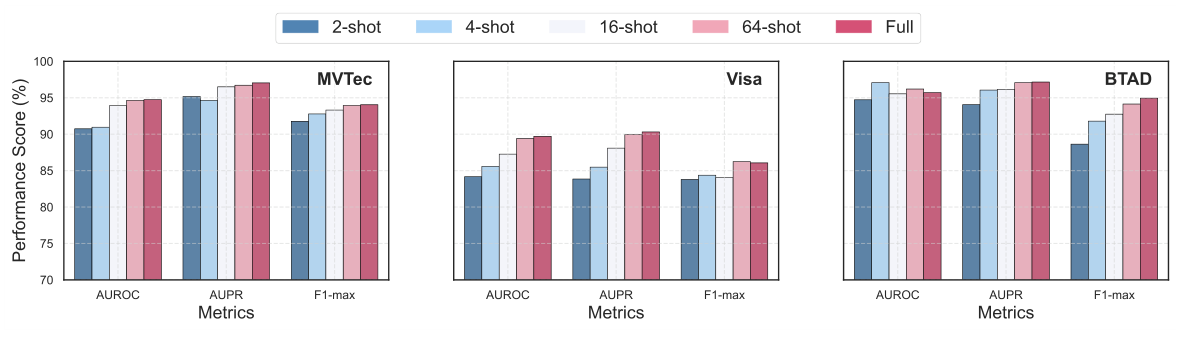
The value of normal support examples
The ablation compares image-level anomaly detection as the normal support set grows.
View in the paperWhat this means
For anomaly detection, limited defect data is a structural condition of the problem. A useful system must extract diagnostic value from what normality makes observable. LAKE frames that task as selecting and reading pretrained knowledge at the appropriate internal locations.
This gives an interpretable way to study adaptation under scarce evidence: which units normal samples select, what deviations they detect, and how performance changes with the normal support set. The same questions help identify when pretrained knowledge is insufficient for a new inspection environment.
Paper and resources
This is an introduction to the linked paper. Refer to the original for method definitions, evaluation settings, and complete results.
Cite this work
@misc{lake,
  title = {Latent Anomaly Knowledge Excavation: Unveiling Sparse Sensitive Neurons in Vision-Language Models},
  author = {Li, Shaotian and Li, Shangze and Shi, Chuancheng and Wu, Wenhua and Wu, Yanqiu and Yu, Xiaohan and Shen, Fei and Chua, Tat-Seng},
  year = {2026},
  eprint = {2604.07802},
  archivePrefix = {arXiv},
  url = {https://arxiv.org/abs/2604.07802}
}