Forensic Reserve: Eliciting Latent Knowledge for Image Forgery Detection
Find a pretrained model’s latent forensic reserve, then constrain lightweight adaptation to those existing directions.

The short version
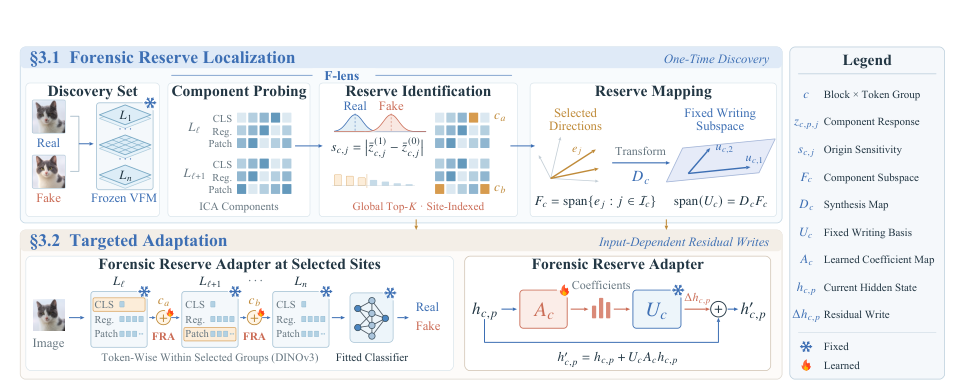
Forensic Reserve studies the forensic signals already present in frozen visual encoders. F-Lens localizes sparse components that distinguish real from generated images, while Reserve-Guided Elicitation adapts constrained subspaces at the selected sites. The model’s internal structure determines where adaptation is allowed to act.
This turns interpretability into an adaptation strategy. Instead of treating every feature and layer as equally useful, the method concentrates its limited examples and trainable parameters on identified forensic reserves. Cross-backbone experiments test whether that strategy transfers beyond a single encoder.
Efficient adaptation starts by locating the task-relevant capacity a pretrained model already contains.
Locate first, adapt selectively
F-Lens finds forensic reserves and FRA adapts the constrained subspaces at selected sites.
View in the paperWhy this matters
A pretrained representation may already contain useful forensic signals that ordinary task adaptation does not specifically exploit. Identifying where those signals reside can guide which components should be adapted.
How it works
- Use F-lens to decompose activations and screen components by real-versus-generated response differences.
- Map selected directions back to hidden-state space and place Forensic Reserve Adapters at identified sites.
- Train only coefficient maps; keep the backbone, fitted reference classifier, and subspace bases fixed.
Where the reserve is located
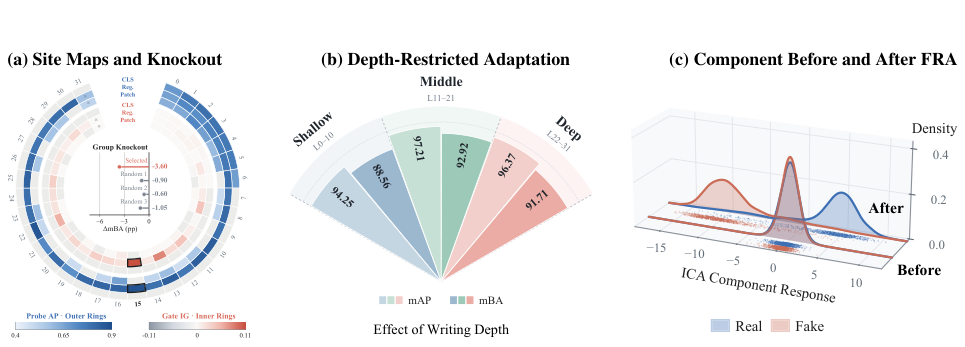
Site maps, depth-restricted adaptation, and component responses examine the structure and use of forensic reserves.
View in the paperWhat the study finds
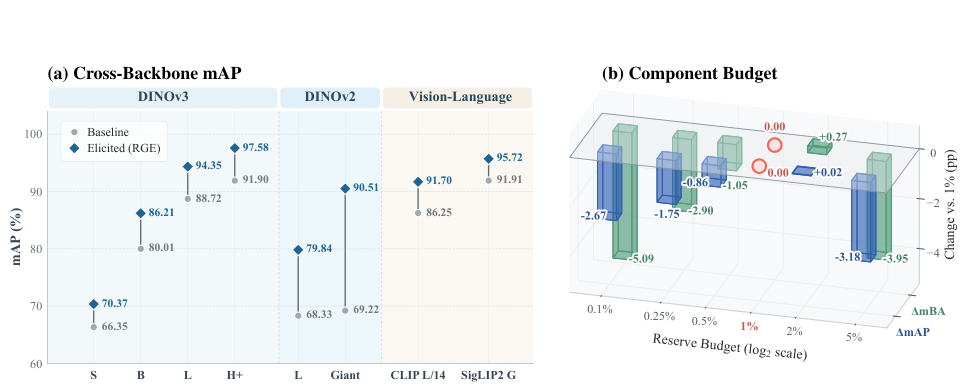
With 500 labelled images and fewer than 0.2% trainable backbone parameters, RGE is evaluated on three benchmarks without target-benchmark adaptation. Improvements over corresponding frozen detectors hold across eight encoders.
Across backbones and component budgets
The plots relate detection performance to backbone choice and the budget of reserve components.
View in the paperWhat this means
The result suggests a concrete connection between understanding a representation and using data efficiently. Locating a task-relevant subspace can reduce the degrees of freedom that must be fitted, helping adaptation exploit existing discrimination rather than reconstruct it from a small dataset.
For forensics, the central test remains robustness to unfamiliar generators and distribution changes. Reserve localization offers a mechanism for studying that robustness: which signals are reused, how adaptation changes them, and when those signals stop separating authentic and synthetic content.
Paper and resources
This is an introduction to the linked paper. Refer to the original for method definitions, evaluation settings, and complete results.
Cite this work
@misc{forensic_reserve,
  title = {Forensic Reserve: Eliciting Latent Knowledge for Image Forgery Detection},
  author = {Li, Jiahua and John, Zixu and Zhong, Tom and Wu, Fuping and Xu, Tianhao and Zheng, Jianqing and Mo, Yuanhan and Shen, Fei},
  year = {2026},
  eprint = {2610.08639},
  archivePrefix = {arXiv},
  url = {https://arxiv.org/abs/2610.08639}
}