DNA: Uncovering Universal Latent Forgery Knowledge
Look for forgery-sensitive anchors already encoded in pretrained models instead of relying only on end-to-end adaptation.

The short version
DNA searches a frozen visual backbone for forgery-discriminative units through a coarse-to-fine procedure. Layer-level geometry narrows the search, while a triadic score and curvature-based selection identify sparse units. A lightweight detector then uses those units to distinguish authentic and synthetic images.
The HIFI-Gen evaluation examines transfer to generators and architectures outside training. This places the emphasis on whether selected representations carry reusable forensic information, beyond the signatures of the generators used to build the detector.
Generalizable forgery detection can begin with discriminative structure already present in pretrained features.
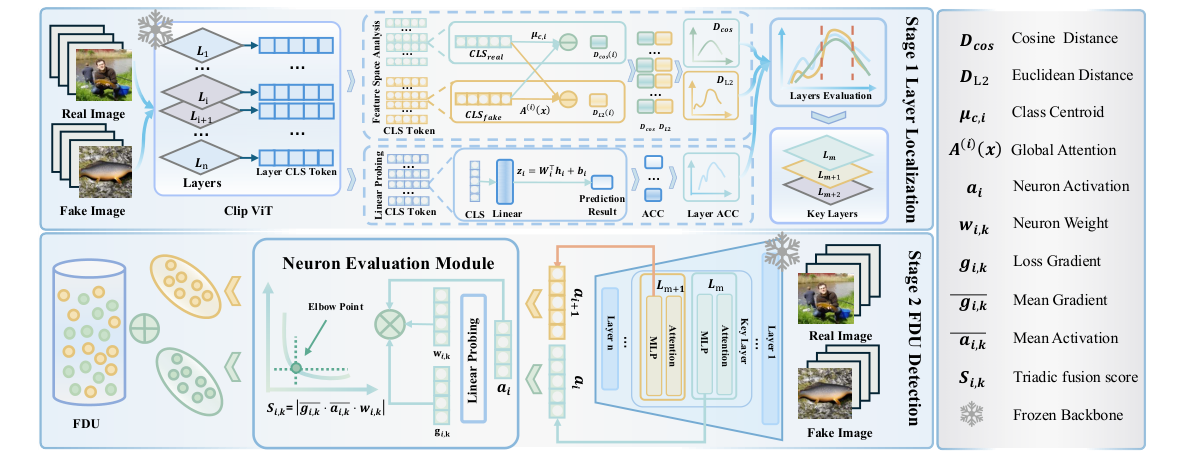
A coarse-to-fine forensic search
Layer localization and discriminative-unit selection extract a compact interface from the frozen backbone.
View in the paperWhy this matters
Task-level adaptation can conceal which pretrained components already carry forensic information. The study asks whether a compact set of such components can serve as a detection basis.
How it works
- Analyze feature decoupling and attention shifts to locate critical intermediate layers.
- Combine triadic scoring with curvature truncation to select forgery-discriminative units.
- Evaluate selected anchors on forgery benchmarks, including the introduced HIFI-Gen dataset.
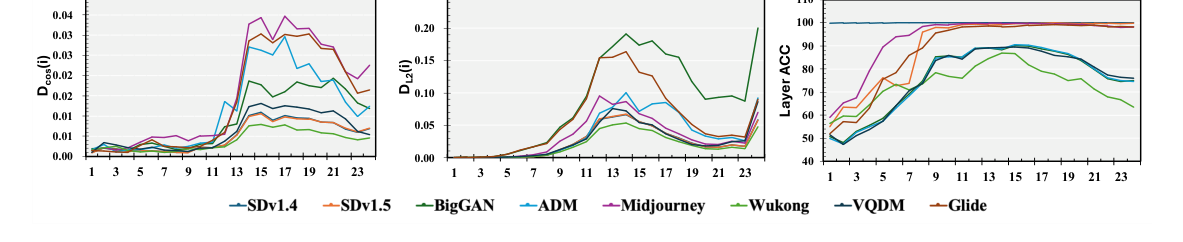
Where class geometry changes
Layer-wise distances between authentic and synthetic distributions inform localization.
View in the paperWhat the study finds
The paper reports strong few-shot detection and robustness across evaluated architectures and unseen generators. Its experiments examine the usefulness of the selected anchors under distribution changes.
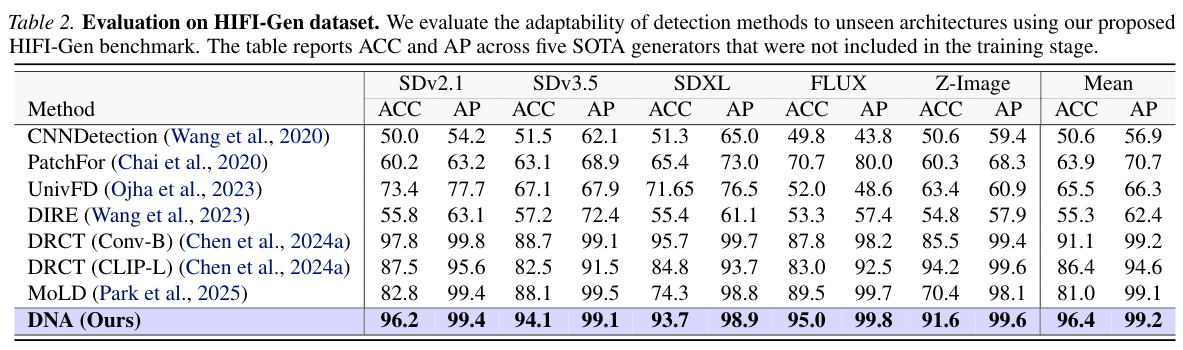
Unseen generators on HIFI-Gen
The table tests detection on generator architectures outside the training stage.
View in the paperWhat this means
The key question in forensics is what survives the next change in generation technology. Internal localization offers a way to investigate that question at the representation level, by examining which discriminative coordinates remain informative when the source of synthetic images changes.
The work suggests a path from pretrained knowledge to a compact, inspectable detection interface. Generalization remains an empirical claim tied to the tested shifts; broader deployment calls for continued evaluation on new generators, processing pipelines, and authentic-image distributions.
Paper and resources
This is an introduction to the linked paper. Refer to the original for method definitions, evaluation settings, and complete results.
Cite this work
@misc{dna,
  title = {DNA: Uncovering Universal Latent Forgery Knowledge},
  author = {Dou, Jingtong and Shi, Chuancheng and Wang, Yemin and Guo, Shiming and Yi, Anqi and Wu, Wenhua and Zhang, Li and Shen, Fei and Chua, Tat-Seng},
  year = {2026},
  eprint = {2601.22515},
  archivePrefix = {arXiv},
  url = {https://arxiv.org/abs/2601.22515}
}