EmoRSS: Mitigating Emotion-Induced Over-Refusal in Large Language Models
Emotional wording can make benign requests look unsafe. EmoRSS steers refusal-related activations to reduce that distortion.

The short version
EmoRSS investigates why emotional expression can push benign requests toward refusal. Paired queries isolate the change in expression, and sparse autoencoder features connect that change to a refusal-related subspace. The method then reverses the estimated shift during inference while keeping the underlying model frozen.
The study evaluates benign assistance and harmful-request refusal together. This matters because a lower refusal rate is useful only when it reflects better calibration of legitimate requests, while preserving the model’s ability to reject harmful ones.
Safety calibration depends on distinguishing harmful intent from the emotional form of a legitimate request.
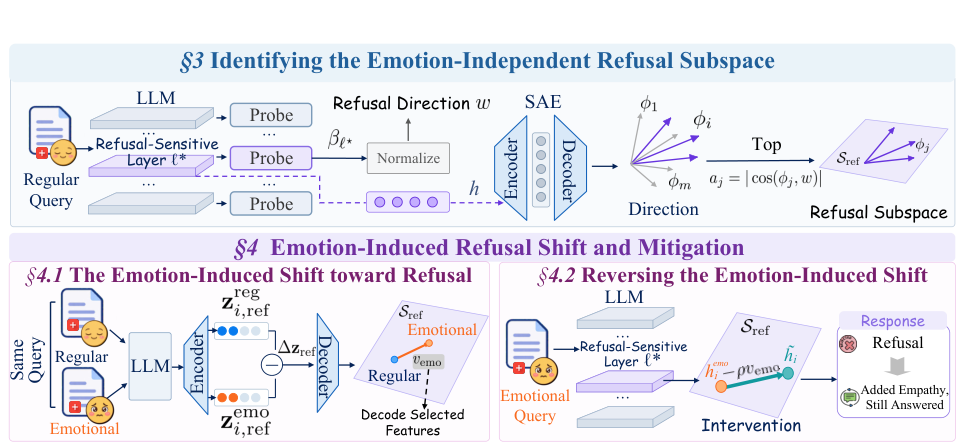
Tracing an emotion-induced refusal shift
The framework identifies a refusal-related subspace and reverses the estimated emotional shift during inference.
View in the paperWhy this matters
Safety decisions should depend on the requested action as well as its context. Benign queries can be unnecessarily refused when emotional expression increases refusal tendencies.
How it works
- Locate a refusal-sensitive layer with linear probes and construct an SAE-based refusal subspace.
- Compare paired regular and emotional versions of the same queries to estimate a mean feature shift.
- Decode that shift into a hidden-state vector and intervene in the reverse refusal direction without backbone updates.
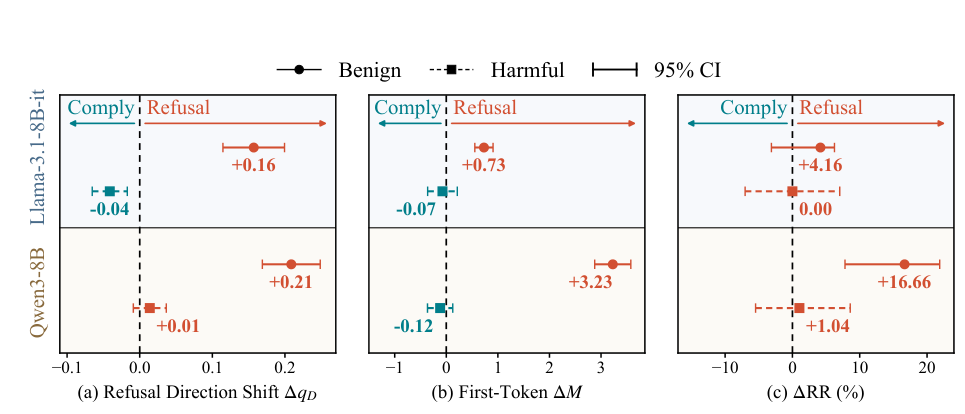
Measuring the shift at three levels
Paired benign and harmful queries are compared in representation, first-token, and full-response measurements.
View in the paperWhat the study finds
Experiments on two LLMs jointly examine harmful-request refusal, benign-request answering, and general performance. The reported trade-off is more favourable than the compared over-refusal mitigation baselines under emotional wording.
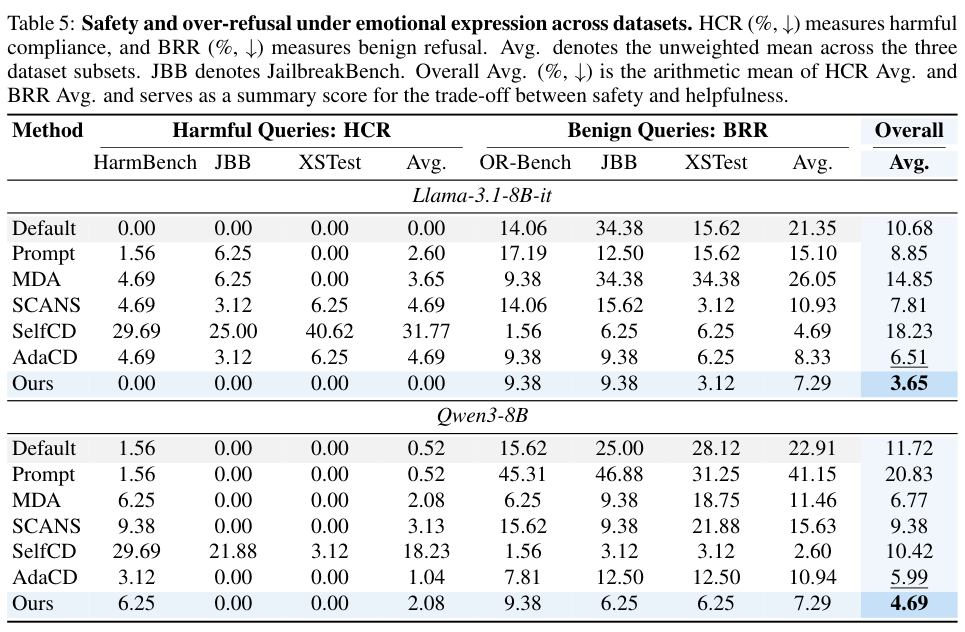
Safety and assistance together
The original table reports harmful compliance and benign refusal under emotional expression; the metrics must be read jointly.
View in the paperWhat this means
Helpful safety requires sensitivity to what a user is asking for and stability to how that need is expressed. Emotional distress can be part of a legitimate request; treating that expression as a substitute for risk can systematically withhold assistance from the people who need it.
By connecting a behavioral disparity to an intervenable internal direction, this work offers a mechanism for studying that calibration. Its scope is defined by the tested models and paired-query settings, motivating broader evaluation across emotions, tasks, and conversational contexts.
Paper and resources
This is an introduction to the linked paper. Refer to the original for method definitions, evaluation settings, and complete results.
Cite this work
@misc{emorss,
  title = {EmoRSS: Mitigating Emotion-Induced Over-Refusal in Large Language Models},
  author = {Miao, Shuyi and Ma, Yaojin and Cui, Chenhang and Liu, Xiaohao and Dang, Jisheng and Zhuo, Shengda and Shen, Fei and Chua, Tat-Seng},
  year = {2026},
  eprint = {2610.04998},
  archivePrefix = {arXiv},
  url = {https://arxiv.org/abs/2610.04998}
}