V-FIND: Revealing the Intrinsic Forgery Knowledge Encoded in Video Forgery Detectors
A compact set of latent anchor neurons exposes reusable forensic signals inside frozen video forgery detectors.

The short version
V-FIND asks how much forensic capability can be recovered from a video detector without retraining its backbone. It locates layers that separate authentic and synthetic videos, then identifies sparse latent anchor neurons carrying consistent discriminative signals. These coordinates form a compact forensic subspace.
A lightweight linear classifier reads the selected subspace while the original backbone remains frozen. External benchmarks and neuron interventions test whether those signals are reusable and functionally relevant, connecting internal localization to observable detection behavior.
A detector’s useful forensic knowledge can be studied as an internal representation that survives a new readout.
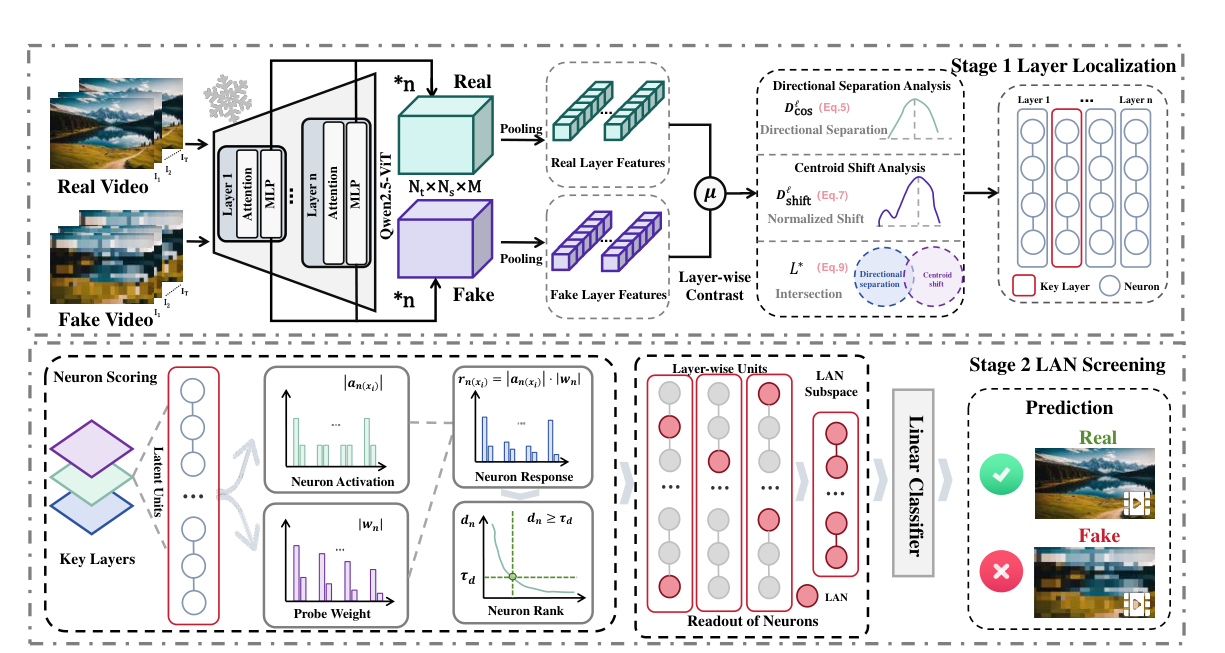
A compact forensic readout
Layer localization and latent-anchor selection precede linear classification from a frozen backbone.
View in the paperWhy this matters
Optimizing a detector as a black box reveals little about which of its learned signals support generalization. Sparse internal localization offers a way to examine the knowledge already present before allocating the cost of further full-model adaptation.
How it works
- Locate critical layers using complementary discrepancies between real and forged video representations.
- Select latent anchor neurons from the localized layers and assemble a compact subspace.
- Train a linear readout with the backbone frozen, then test external generalization and targeted neuron interventions.
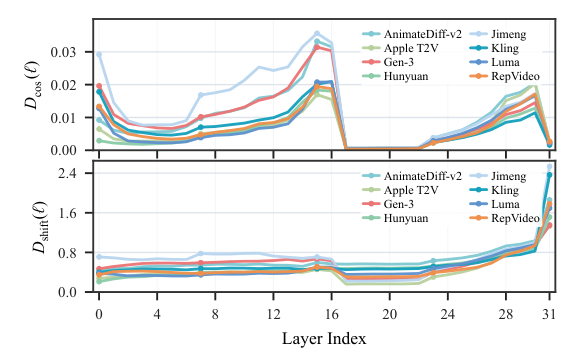
Locating informative layers
The two discrepancy signals vary with depth across eight fake-source subsets.
View in the paperWhat the study finds
The selected results show layer-localization signals and detection comparisons on external generated-video benchmarks. The study also uses fixed-budget controls, depth restrictions, cross-architecture checks, and paired activation swaps to examine whether the selected units contribute beyond a favorable feature budget.
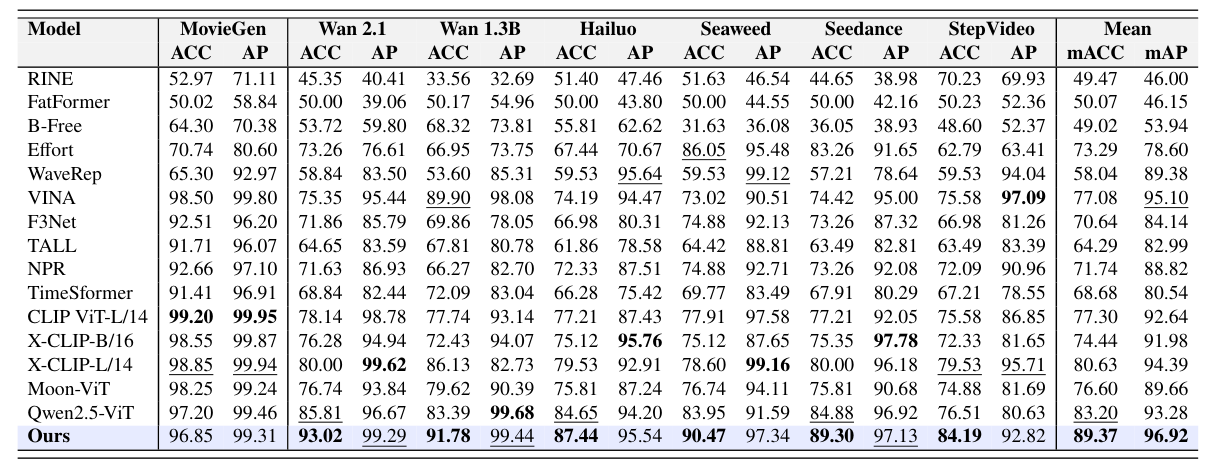
Detection beyond the discovery setting
The original table compares accuracy and average precision on external generated-video datasets.
View in the paperWhat this means
The work turns a trained detector into a source of inspectable and potentially reusable knowledge. A successful sparse readout helps separate the capacity stored in a representation from the particular classifier that originally exposed it.
Generalization still depends on which distinctions those coordinates capture. External-generator tests and activation swaps make that question more concrete: they examine both where the signal transfers and how changing the selected representation changes the decision.
Paper and resources
This is an introduction to the linked paper. Refer to the original for method definitions, evaluation settings, and complete results.
Cite this work
@misc{v_find,
  title = {V-FIND: Revealing the Intrinsic Forgery Knowledge Encoded in Video Forgery Detectors},
  author = {Kan, Shichao and Hong, Chengpeng and Dou, Jingtong and Shi, Chuancheng and Liu, Yuhan and Xu, Linrui and Liang, Yixiong and Cen, Yigang and Sun, Yanpeng and Shen, Fei and Chua, Tat-Seng},
  year = {2026},
  eprint = {2608.03008},
  archivePrefix = {arXiv},
  url = {https://arxiv.org/abs/2608.03008}
}